Home  /  Archives  /  Vol 1, Issue 1  /  Article
Research Article
Kruti Thakkar, Salvi Shah

Relationship of Body Mass Index, Aerobic Capacity, and Heart Rate Variability in Perimenopausal and Postmenopausal Women: A Correlational Study

[Year:2025] [Month:August - October] [Volume:1] [Number:1] [Pages:8] [Pages No:13-20]
Keywords: 6-minute walk test, aerobic capacity, autonomic function, body mass index, heart rate variability, menopause
DOI: 10.00000/aijhris.2025.0102| Open Access| How to cite| Citations 0 | 412 views Download PDF
Relationship of Body Mass Index, Aerobic Capacity, and Heart Rate Variability in Perimenopausal and Postmenopausal Women: A Correlational Study
Abstract Full Text References Keywords
Abstract
Aims: To examine the associations between body mass index (BMI), aerobic capacity, and heart rate variability (HRV) in peri- and postmenopausal women. Methods: A cross-sectional study of 100 women aged 45-60 years assessed BMI, the 6-minute walk test, and HRV. Results: HRV (SDNN) was significantly higher in perimenopausal (51.5 ms) than postmenopausal women (44.8 ms; P = 0.003). Conclusion: Autonomic function declines markedly after menopause, while aerobic capacity and HRV behave as independent parameters requiring targeted intervention.

Introduction

The menopausal transition is accompanied by hormonal and functional changes that influence cardiovascular and autonomic health. Heart rate variability (HRV) and aerobic capacity are established markers of autonomic and cardiorespiratory function respectively.

Methodology

Study design

A cross-sectional, correlational study recruited 100 women aged 45 to 60 years, equally divided between perimenopausal and postmenopausal groups using stratified random sampling.

Outcome measures

BMI was calculated using the standard formula. Aerobic capacity was assessed with the 6-minute walk test. HRV was recorded with a chest-strap monitor, using the standard deviation of normal-to-normal intervals (SDNN) as the primary metric.

Results

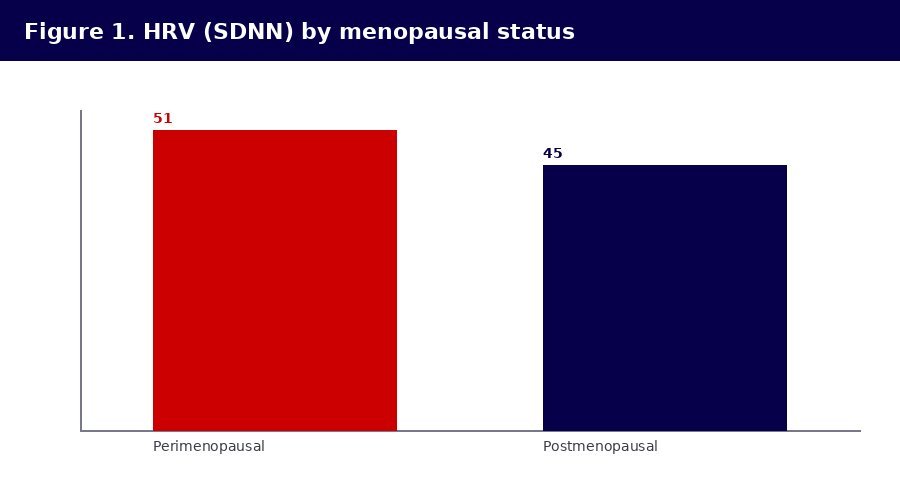
The mean HRV was significantly higher in perimenopausal women (51.5 ms) than in postmenopausal women (44.8 ms), with P = 0.003, indicating a decline in autonomic function as menopause advances. A weak negative correlation was observed between BMI and aerobic capacity, while HRV and the 6-minute walk test were not significantly correlated.

VariablePerimenopausalPostmenopausalP value
HRV / SDNN (ms)51.544.80.003
6-MWT distance (m)4834700.247

Discussion

The pronounced decline in HRV after menopause is consistent with reduced parasympathetic tone associated with falling oestrogen. The minimal correlation between aerobic capacity and HRV suggests each reflects a distinct dimension of health.

Conclusion

Higher BMI and reduced aerobic capacity are moderately associated, whereas HRV declines independently after menopause. Tailored interventions targeting weight, fitness, and autonomic regulation are recommended.

References

  1. Maltais F, Simard AA, Simard C. Aerobic capacity and aging in women. Can J Physiol Pharmacol. 2001;79:846-52.
  2. Seals DR, Taylor JA. Aerobic exercise and autonomic function in aging adults. J Physiol. 2002;547:985-95.
  3. Woo JS, Derleth C, Stratton JR. The influence of menopause on autonomic balance. Menopause. 2020;27:331-8.
Keywords: 6-minute walk test aerobic capacity autonomic function body mass index heart rate variability menopause
Download Full Text (PDF) View Full Issue

Related Articles in This Issue

Advancing Interdisciplinary Healthcare Research: The AIJHRIS Vision
Swapnil V. Rahane
Evidence-Based Nursing Interventions for Post-Operative Patient Safety: A Quality-Improvement Study
Swapnil V. Rahane, Ravindra H.N
Atypical Presentation of Guillain-Barre Syndrome Following Routine Vaccination: A Case Report
Priya Nair, Anita Deshmukh
Telerehabilitation Uptake Among Rural Physiotherapy Patients: A Short Communication
Hemantkumar Patadia